
Have you ever received a text saying “TTM” and wondered what the sender meant? You are not alone. Texting abbreviations are common in everyday conversations, social media messages, and dating apps. Learning their meanings can help you understand messages and respond with confidence.
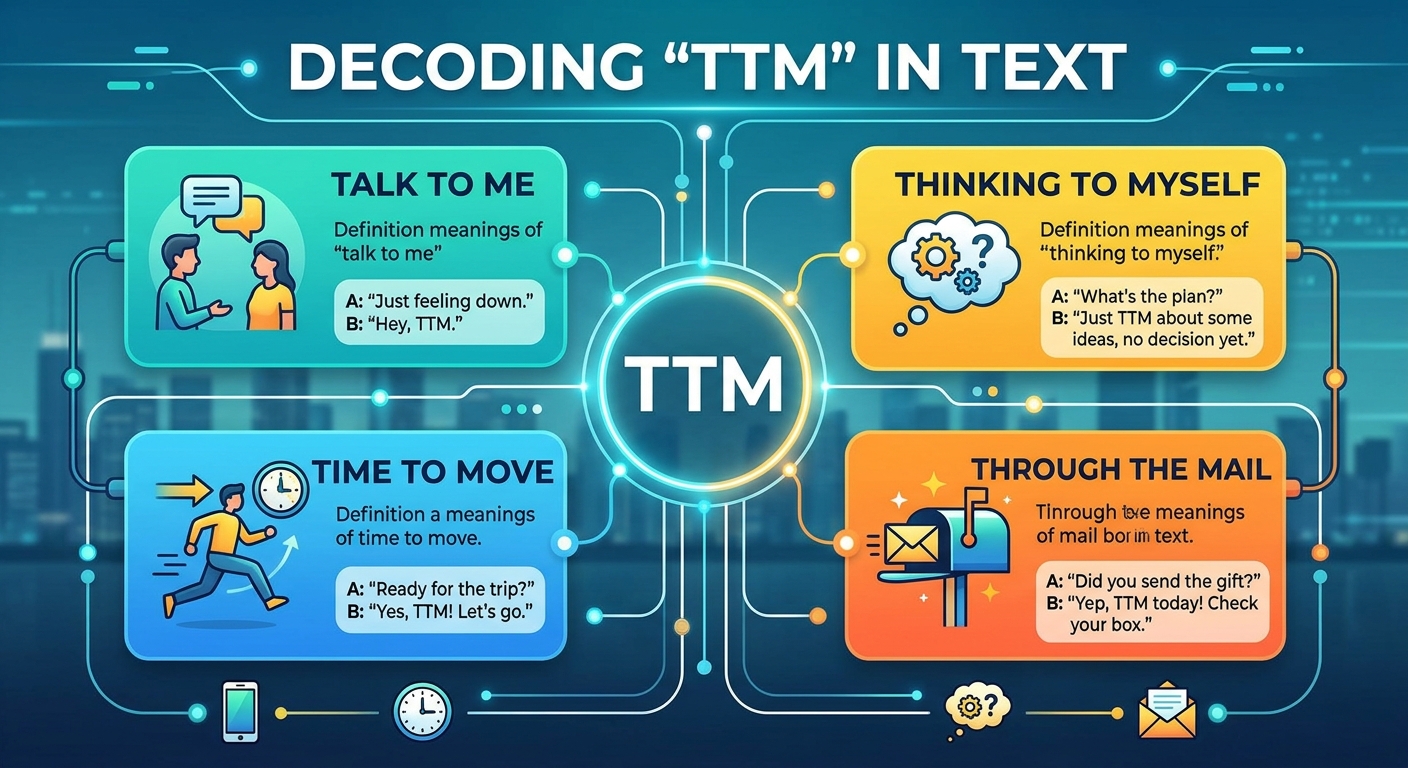
The most common TTM meaning in text messages is “Talk To Me.” People use this abbreviation when they want someone to start a conversation, share their thoughts, or respond to a message. Depending on the situation, it can sound friendly, caring, playful, or direct.
However, TTM can have different meanings in business, finance, and other professional fields. Context is important when interpreting this abbreviation. This guide explains the meaning of TTM, its origin, its use across social media platforms, and practical examples to help you understand it correctly.
Meaning & Definition
TTM usually stands for Talk To Me in texting and online conversations. It is an informal abbreviation created from the first letters of each word. People use it to invite someone to communicate without typing the complete phrase.
For example, a friend might send, “You seem upset. TTM if you need anything.” This message means the friend is available to listen and wants the recipient to feel comfortable talking.
TTM can express several intentions, including:
- Starting a casual conversation.
- Encouraging someone to reply.
- Asking a friend to share their feelings.
- Reconnecting with someone after a long time.
- Showing interest in another person’s experiences.
- Inviting someone to continue a discussion.
The abbreviation is generally friendly and informal. Its exact tone depends on the sender, the relationship between the people, and the surrounding message.
What Does TTM Meaning in Text?
When someone sends TTM in a text message, they usually mean “Talk To Me.” It is a quick way to ask another person to communicate. The sender might be bored, curious, concerned, or interested in having a conversation.
For instance, someone might text, “Hey, TTM when you’re free.” This means they would like to talk but are not necessarily demanding an immediate response. Similarly, a close friend might use TTM to encourage someone to discuss a personal problem.
Here are some common situations where TTM appears:
- Casual chatting: “I’m bored. TTM!”
- Emotional support: “I’m here for you. TTM anytime.”
- Reconnecting: “It’s been weeks. TTM soon!”
- Romantic conversations: “You seem interesting. TTM later?”
- Sharing news: “I have something exciting to tell you. TTM!”
Remember that TTM does not automatically indicate romantic interest or urgency. Reading the complete message will help you understand the sender’s intention.
Background / Origin
The exact origin of TTM as a texting abbreviation is not clearly documented. It likely developed as part of the broader trend of shortening everyday phrases for faster digital communication.
As mobile phones, instant messaging, and online chat services became popular, people began using abbreviations such as LOL, BRB, IDK, and TTYL. These shortcuts helped users communicate quickly, especially when typing on older mobile keyboards.
TTM follows the same pattern. Instead of writing “Talk to me,” a person can use three letters to express the same basic idea. Over time, similar abbreviations became common in private messages, social media comments, and online communities.
There is no reliable evidence establishing a single creator or a specific launch date for TTM. Therefore, it is best understood as informal internet slang rather than an abbreviation invented by one particular platform.
Usage in Different Contexts
TTM can communicate different intentions depending on the situation. Understanding the relationship between the sender and recipient can help you interpret its meaning.
General Usage
In everyday conversations, TTM is commonly used to invite someone to chat. Friends may send it when they want company, need advice, or simply want to catch up.
For example, a friend might write, “I haven’t heard from you lately. TTM when you can.” This message invites a conversation without putting too much pressure on the recipient.
Other examples include:
- “TTM after your class.”
- “Something happened today. TTM!”
- “You can TTM whenever you need help.”
- “I’m free tonight, so TTM.”
- “Let’s catch up soon. TTM this weekend.”
TTM works best when the people involved understand casual texting language. In unfamiliar conversations, writing the full phrase may prevent confusion.
Formal vs Informal Usage
TTM is mainly suitable for informal communication. It works well between friends, family members, partners, and people who regularly exchange casual messages.
In professional settings, however, the abbreviation may appear unclear or overly casual. Writing a complete sentence is usually better when contacting a manager, customer, client, or business partner.
| Situation | Suggested wording | Why it works |
| Chatting with a friend | TTM when you’re free | Casual and friendly |
| Messaging a partner | TTM later ❤️ | Personal and relaxed |
| Contacting a colleague | Let me know when you are available to talk | Clear and professional |
| Writing a business email | Please contact me when convenient | Polite and appropriate |
| Supporting someone | I’m here if you want to talk | Warm and considerate |
Choose your wording based on the audience and purpose. Clear communication is more important than using abbreviations.
TTM Meaning on Social Media Platforms
TTM appears in online conversations across platforms such as Instagram, Snapchat, TikTok, WhatsApp, and Facebook Messenger. In most casual messages, it means “Talk To Me.”
On Instagram, someone might use TTM in a direct message to start a conversation. On Snapchat, a friend might send it when they want company. On TikTok, it may appear in comments or private messages when someone wants to connect with another user.
Examples include:
- Instagram: “TTM sometime. We haven’t caught up in ages!”
- Snapchat: “Bored tonight. TTM 😂”
- TikTok: “You seem cool. TTM!”
- WhatsApp: “TTM when you get home.”
- Facebook Messenger: “I have news for you. TTM when you’re free.”
TTM is not an official feature of these platforms. It is an informal expression that users adopt in their own conversations.
The intended meaning can still vary between communities. If a message uses unfamiliar slang or has an unusual context, ask the sender what they mean rather than assuming every abbreviation has one universal definition.
Other Meanings in Different Fields
Although “Talk To Me” is the common interpretation in casual texting, TTM can represent other terms in professional and technical settings.
| Field | Meaning of TTM | Explanation |
| Text messaging | Talk To Me | An invitation to communicate |
| Finance | Trailing Twelve Months | Financial performance over the most recent twelve months |
| Business | Time To Market | The time required to develop and launch a product |
| Technology | Context-dependent abbreviation | Meaning varies by system or organization |
In finance, trailing twelve months is used to evaluate recent company performance. It can help investors review revenue, earnings, and other financial measures over a rolling twelve-month period.
In business and product development, time to market refers to the period between beginning product development and making the product available to customers.
These meanings differ significantly from texting slang. When you see TTM in a financial report, business document, or technical discussion, consider the subject before interpreting it.
Examples of TTM Meaning in Text in Sentences
Real-life examples make texting abbreviations easier to understand. The following conversations show how people might use TTM in different situations.
Example 1: Casual conversation
Alex: “I’m home and bored.”
Sam: “Same here. TTM!”
Meaning: Sam wants to chat.
Example 2: Emotional support
Mia: “I’ve had a really difficult day.”
Lily: “I’m sorry. TTM if you want to talk about it.”
Meaning: Lily is offering support.
Example 3: Reconnecting with a friend
Chris: “We haven’t talked in weeks.”
Taylor: “I know! TTM this weekend.”
Meaning: Taylor wants to reconnect.
Example 4: Romantic conversation
Jordan: “I enjoyed meeting you yesterday.”
Casey: “Me too! TTM tonight?”
Meaning: Casey wants to continue the conversation. The message could be flirty, but it does not prove romantic interest by itself.
Example 5: Asking for more details
Morgan: “How did your interview go?”
Riley: “It went better than expected.”
Morgan: “Great! TTM about it when you’re free.”
Meaning: Morgan wants to hear more about the interview.
These examples show that TTM can be friendly, supportive, or playful. The meaning depends on the conversation.
Common Misconceptions
People sometimes misunderstand TTM because texting slang can change across different communities. Knowing the common misconceptions can help you avoid incorrect assumptions.
- TTM always means romantic interest: Not true. It often appears in ordinary conversations between friends.
- TTM is rude: The abbreviation is generally neutral. Its tone depends on how it is used.
- TTM has the same meaning everywhere: Not true. Its meaning changes across texting, finance, and business.
- Capital letters mean anger: Uppercase letters may simply be the sender’s typing style.
- TTM requires an immediate response: It does not automatically create an obligation to reply at once.
- TTM is an official social media feature: It is informal shorthand, not a platform-specific function.
The best way to understand TTM is to consider the complete message and the relationship between the people communicating.
Similar Terms & Alternatives
TTM is one of many abbreviations used in everyday digital communication. Some have similar purposes, but their meanings are different.
| Abbreviation | Full form | Typical use |
| TTM | Talk To Me | Invites conversation |
| HMU | Hit Me Up | Encourages someone to contact you |
| TTYL | Talk To You Later | Indicates that you will talk later |
| WYD | What You Doing? | Asks what someone is doing |
| WYA | Where You At? | Asks about someone’s location |
| BRB | Be Right Back | Indicates a short absence |
| IDK | I Don’t Know | Expresses uncertainty |
| DM | Direct Message | Refers to a private message |
For example, “TTM when you’re free” directly invites conversation, while “HMU when you’re free” generally asks someone to make contact. TTYL, in contrast, is commonly used to end a conversation temporarily.
If you prefer not to use slang, you can write “Let’s talk,” “Message me,” “Tell me what’s happening,” or “I’m here to listen.” These alternatives communicate your intention clearly.
How to Respond to TTM Meaning in Text When Someone Uses It
Your response to TTM depends on whether you want to talk and how well you know the sender. If you are available, a simple reply can keep the conversation moving.
Here are several responses you can use:
- Friendly: “Sure! What’s up?”
- Supportive: “I’m here. What’s going on?”
- Playful: “Haha, about what? 😂”
- Romantic: “Of course! How’s your evening going?”
- Busy: “I’m busy right now, but I’ll text you later.”
- Uncertain: “What do you mean by TTM?”
- Setting a boundary: “I can’t talk right now, but I’ll reach out when I can.”
If the sender seems worried about you, you can acknowledge their concern without sharing anything you do not feel comfortable discussing.
You also do not need to respond immediately. A text message is an invitation to communicate, not an obligation to be available at all times.
Difference Between TTM Meaning in Text and Similar Terms
TTM, HMU, TTYL, and WYD are common abbreviations, but they communicate different intentions.
TTM usually means “Talk To Me.” It encourages a conversation or invites someone to share information. HMU means “Hit Me Up,” which is a broader request to get in touch. TTYL means “Talk To You Later” and is generally used when ending a conversation for now.
WYD asks what someone is doing, while WYA asks where someone is. These expressions request specific information rather than directly inviting someone to open up.
| Term | Main intention | Example |
| TTM | Invite conversation | “TTM when you’re free.” |
| HMU | Ask someone to contact you | “HMU this weekend.” |
| TTYL | End the current conversation temporarily | “I have to go. TTYL.” |
| WYD | Ask about an activity | “WYD tonight?” |
| WYA | Ask about a location | “WYA right now?” |
Understanding these differences helps you interpret messages more accurately and respond appropriately.
Relevance in Online Conversations & Dating Apps
TTM is useful in online conversations because it allows people to invite communication with very few words. It can help friends reconnect, encourage someone to respond, or make a conversation feel more relaxed.
On dating apps, a person might send “You seem interesting. TTM when you’re free” to encourage further conversation. The message can suggest interest, but the abbreviation alone does not establish romantic attraction.
When interpreting TTM on dating platforms, consider the surrounding messages and how the other person communicates. Someone who asks thoughtful questions and responds consistently may be showing interest, but no single abbreviation can confirm their intentions.
Keep these tips in mind when chatting online:
- Read the full message before deciding what it means.
- Consider your existing relationship with the sender.
- Avoid assuming that every friendly message is romantic.
- Ask for clarification when the meaning is uncertain.
- Protect personal information when communicating with strangers.
- Reply when you feel comfortable and have time.
Online conversations are easier when both people communicate clearly and respect each other’s boundaries.
Frequently Asked Questions
1. What does TTM mean in text messages?
TTM usually means “Talk To Me.” It is an informal abbreviation used to invite someone to chat, respond, or share their thoughts.
2. What does TTM mean from a girl or a guy?
The meaning is generally the same regardless of who sends it. It usually means “Talk To Me,” although the surrounding conversation may reveal whether the message is friendly, supportive, or flirty.
3. Does TTM mean someone likes you romantically?
Not necessarily. TTM can appear in romantic conversations, but friends also use it to start chats or offer support. Consider the broader conversation before assuming romantic interest.
4. What does TTM mean on Instagram or Snapchat?
On Instagram and Snapchat, TTM usually means “Talk To Me.” Users may send it in direct messages or comments to encourage another person to start a conversation.
5. Is TTM rude or disrespectful?
TTM is not generally rude or disrespectful. However, wording such as “TTM right now” may sound demanding depending on the relationship and situation.
6. How should I reply when someone texts TTM?
You can respond with “Sure, what’s up?” or “I’m listening.” If you are busy, say that you will reply when you have time.
7. Can TTM have a different meaning outside texting?
Yes. In finance, TTM commonly means “Trailing Twelve Months.” In business, it can mean “Time To Market.” The context determines the correct interpretation.
Conclusion
TTM meaning in text messages is usually “Talk To Me.” It is a simple abbreviation used to invite conversation, encourage a reply, or ask someone to share their thoughts. You may encounter it in private messages, social media comments, group chats, and dating app conversations.
Although TTM is common in informal communication, it can have other meanings in professional fields. Finance and business use the same abbreviation for different concepts. Understanding the surrounding context helps you choose the correct interpretation.